 SimSmsBox
 Short answer: A generator assembles digits that match a numbering plan — nothing more. Those digits were never provisioned on any network and belong to no one, so an SMS gateway has nowhere to deliver to. A generated number cannot receive a verification code, and no platform can fix that.
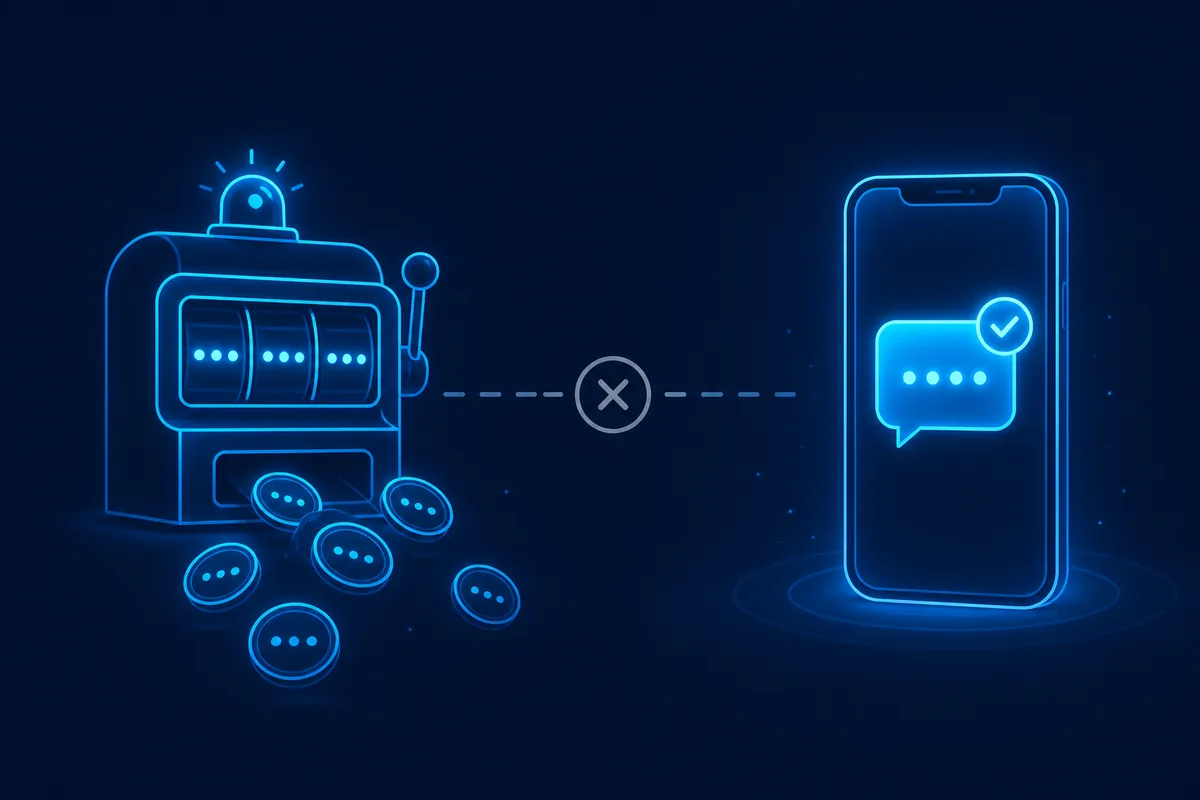
The phrase “phone number generator” hides two completely different needs. One group wants a line that receives codes; the other wants bulk test data. Generators fail the first job entirely and do the second job well.
What a generator actually does
The process is trivial:
- Take a country’s numbering rules — length, valid leading digits, allowed blocks.
- Fill the remaining positions at random.
- Optionally re-check length and prefix so the result “looks real”.
Valid format is not the same as a provisioned line. For a text to arrive, a carrier must have an active subscription for that number in its HLR, tied to a SIM or eSIM. A generator never touches a carrier and has no way to create that record. See what is an HLR lookup.
Generated numbers vs platform numbers
| Generated number | Platform number | |
|---|---|---|
| Provisioned on a network | No | Yes |
| Can receive SMS | No | Yes |
| Who owns it | Nobody — or an unlucky stranger | The provider’s pool |
| Right use | Test data, form validation | Receiving codes |
Row three deserves attention. Random digits frequently collide with a real subscriber’s number. Use one for signup and the code goes to a stranger’s handset, who then gets messages they never asked for.
The legitimate use: test data
Development and QA genuinely need many well-formed, non-real numbers to exercise form validation, database fields, and import paths. For that, prefer the reserved test ranges regulators set aside precisely so they are never assigned to a subscriber — you get format validity without hitting a real person.
What you need instead: a live line
If the goal is passing phone verification, there are only three sources of a real, on-network line:
- Your own number, a carrier second line, or an eSIM — see can you use an eSIM to receive SMS codes.
- A per-code number from an SMS platform — see overseas SMS verification tutorial.
- Online reception when you have no SIM at all — see how to receive SMS online without a SIM.
The cost comparison across all routes is in how to get a virtual phone number.
Three consequences of registering with a fake number
- You stall at step one. Anything with SMS verification stops you immediately.
- Account recovery is dead on arrival. Even where signup succeeds, the next password reset or new-device login needs that number, and you will never see it.
- It usually breaks the terms of service. Submitting false contact details is explicitly prohibited on most platforms.
Even real pool numbers can fail
A provisioned line still gets blocked when the range sits on an app’s blocklist, when the carrier filters the traffic, or when the number’s reputation has already sunk. Work through why isn’t your virtual number receiving SMS, and read SMS number sourcing explained for why pools differ so much.
Summary
Generators produce formats; carriers produce lines. Use reserved test ranges for test data, and a real provisioned number for verification. Confusing the two turns every later troubleshooting step into wasted effort.