 SimSmsBox
 Quick answer: An HLR lookup asks the carrier’s database — before a text is sent — whether a number really exists, can receive SMS right now, which carrier it belongs to, and whether it’s roaming. It helps senders drop dead numbers, pick the right route, and lift delivery success while wasting less money.
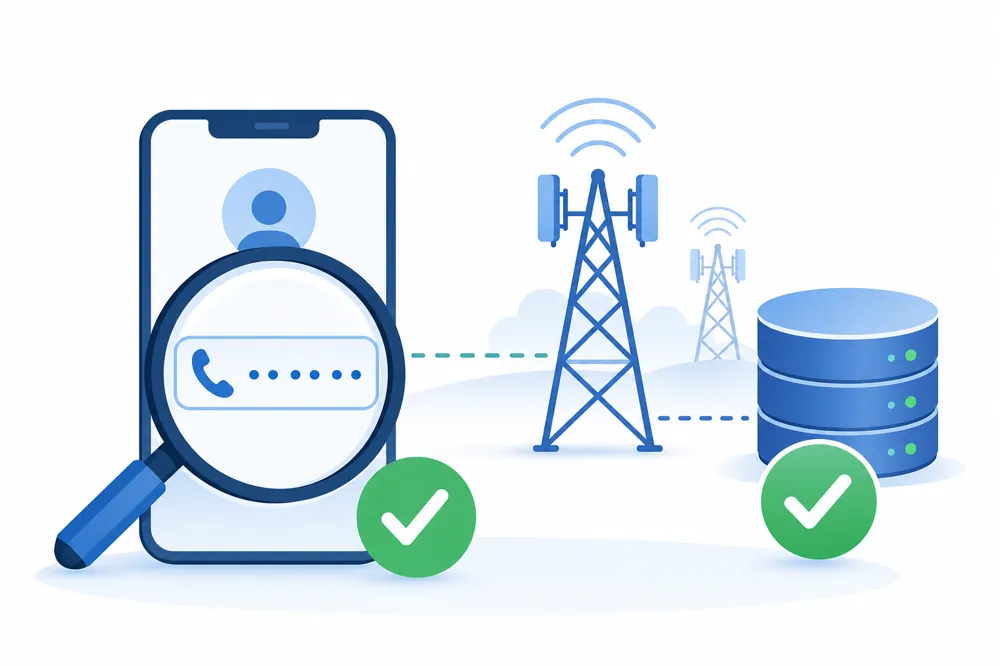
HLR stands for Home Location Register — the core carrier database that tracks the “status” of every mobile number. An HLR lookup is simply asking that database, before actually sending a code, whether this number is worth sending to.
1. What an HLR lookup checks
Sending an A2P verification text costs money, and sending to a disconnected or nonexistent number is pure waste — with no feedback either. An HLR lookup returns a few key facts up front:
- Is the number valid — is this string a real, assigned number?
- Is it reachable now — is the handset on and registered, or disconnected?
- Home carrier (MCC/MNC) — which network owns it now, which matters after a port-out.
- Is it roaming — on another network, which affects routing and latency.
2. Why senders bother
| Goal | What the lookup delivers |
|---|---|
| Save money | No texts wasted on dead numbers |
| Better delivery | Route via the current carrier’s good path |
| List hygiene | Drop invalid numbers, protect sender reputation |
| Fraud checks | Flag risky ranges and virtual numbers |
The real value is routing: knowing which carrier owns the number right now lets a sender pick a high-quality direct route instead of a cheap grey route. That’s the difference between a code arriving in 2 seconds and one vanishing into a filter.
3. HLR lookup vs number validation
Don’t confuse it with simple format validation. Format checks only look at whether the digits “look right” (length, country code) — offline and free. An HLR lookup queries the carrier network in real time and returns the number’s actual live status. The former catches typos; the latter tells you whether the number can really receive a code right now.
4. How it relates to receiving codes
If you’re using a number to receive verification codes, the sender likely ran an HLR lookup on it first. That explains a few things:
- Why some number ranges never get codes — they may be flagged as risky or the wrong line type.
- Why switching carriers can require re-verification — the home-carrier record in the HLR changed.
- Why reachability matters so much — the number must be on and visible for a code to be sent at all.
For reliable codes, a real, on-network, clean-type number beats everything — which is exactly why number sourcing drives deliverability.
5. Are there privacy concerns?
An HLR lookup returns network-layer technical status (reachable, which carrier, roaming) — not message content, call records, or your location trail. It’s a routine part of telecom routing. What deserves caution is someone using it for number-liveness probing to build target lists for spam or scams — but that’s abuse, not the technology’s purpose.
FAQ
Q: Can an HLR lookup see my texts or location? No. It returns network facts like reachability, home carrier, and roaming status — not content, and not precise location.
Q: Why do some verification services check the number before sending? To avoid spending on invalid numbers and to route valid ones correctly, which raises delivery rates.
Q: Can an HLR lookup tell if a number is VoIP? It gives strong hints. Combined with range and carrier data, senders often use it to spot non-VoIP vs virtual numbers.
Takeaway
An HLR lookup confirms with the carrier database that a number “exists, is reachable, belongs to this carrier, and is/isn’t roaming” before a code is sent. It helps senders save money, route correctly, and improve delivery; for you, a real, on-network, clean-type number is the key to codes that arrive reliably.