 SimSmsBox
 Quick answer: A magic link and an OTP code are two flavors of the same passwordless idea — prove you control an inbox or number instead of remembering a password. A magic link is a one-time URL you click; an OTP is a short code you type. Links are frictionless on the same device but awkward across devices; codes are portable and work anywhere you can read them, which is why phone-based SMS OTP is still the more flexible of the two.
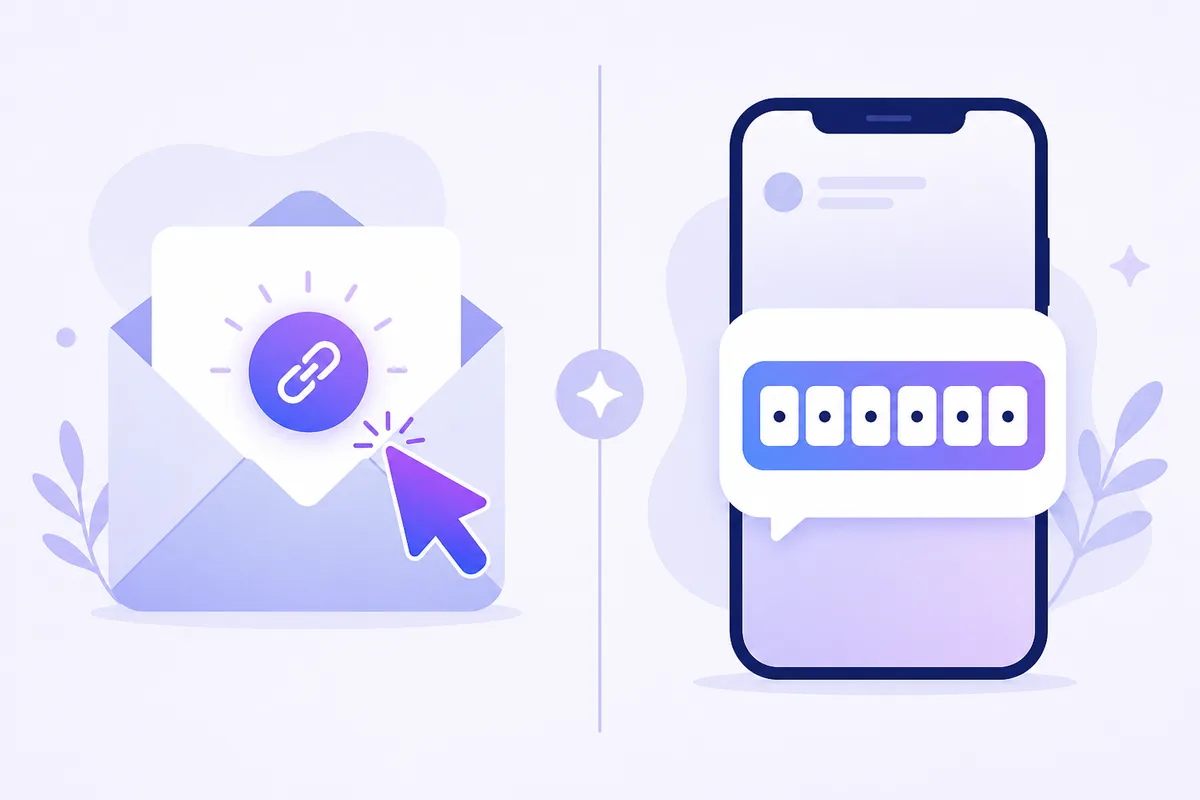
Passwordless login usually shows up in one of two shapes: an email that says “click here to sign in,” or a message with a six-digit code. They solve the same problem — no password to steal or forget — but they behave very differently the moment you’re juggling two devices. Here’s how each works and when one clearly beats the other.
1. Two ways to prove the same thing
Both methods verify that you control a channel — an email inbox or a phone number — that the account is tied to:
- Magic link: The service emails a unique, one-time, time-limited URL. Clicking it opens an already-authenticated session. The “secret” is baked into the link.
- OTP code: The service sends a short code to your email or number. You type it into the login screen. The secret is the code itself, entered by hand.
Under the hood both are single-use tokens with a short expiry. The only difference is delivery: a link you click versus a code you carry to another screen.
2. Where they diverge in real use
| Factor | Magic link | OTP code |
|---|---|---|
| Same-device login | Very smooth — one click | Fine — read and type |
| Cross-device login | Awkward — link opens on the wrong device | Easy — codes are portable |
| Delivery channel | Almost always email | Email or SMS |
| Fails if… | The link opens in a different browser/app | The code doesn’t arrive |
| Copy/paste friendly | Long URL, sometimes mangled | Short, easy to relay |
The cross-device row is the crux. If you request a magic link on your laptop but the email opens the link on your phone, you can end up logged in on the wrong device. A code sidesteps that entirely — you read it wherever it lands and type it wherever you’re logging in.
3. Which should a service use?
It depends on the flow. Magic links shine for email-first products where people log in occasionally on one main device — the single click is lovely. OTP codes win when logins are frequent, cross-device, or phone-based, and they compare directly with the trade-offs in SMS vs email verification. Many services offer both, or blend them with an authenticator app for a second factor.
One security note: both are only as safe as the channel. A magic link sitting in a breached inbox is a live key, and codes have their own risk from OTP bot scams. Short expiry times exist precisely to limit that window.
4. What this means if you receive codes online
Delivery channel is everything here. A magic link almost always arrives by email, so an SMS-receiving service doesn’t touch that flow — you’d need access to the inbox. An OTP, by contrast, is often sent by SMS, and an SMS code is exactly what you can receive online without a SIM.
So the practical rule: if a login offers a texted code, an online number can complete it; if it insists on emailing a magic link, you need the email account instead. When you get to choose “email me a link” vs “text me a code,” the code is the phone-friendly, portable option.
FAQ
Q: Is a magic link more secure than a code? Neither is inherently safer — both are one-time tokens. Security depends on the channel (a compromised inbox exposes links; a phished code exposes OTPs) and on short expiry.
Q: Why did clicking a magic link log me in on the wrong device? Because the link carries the session, and it opens wherever your email app does. Cross-device logins are exactly where codes are more convenient.
Q: Can I receive a magic link on an online number? Usually no — magic links are emailed. Online numbers receive SMS, so they fit code-based (OTP) logins, not link-based ones.
Takeaway
Magic links and OTP codes are the same passwordless token dressed differently: a link you click on one device, or a code you carry to any device. Links feel magical on a single screen but stumble across devices — and since links travel by email while codes often travel by SMS, the texted code remains the portable, phone-friendly option an online number can actually receive.