 SimSmsBox
 Quick answer: Carriers recycle phone numbers — when someone gives up a number, it’s cleaned and reassigned to a new person months later. The security catch: if the previous owner linked that number to accounts and didn’t unlink it, the new holder can receive password-reset and verification codes for those accounts. Recycled numbers are why “reuse an old number” and “reset via SMS” occasionally collide, and why you should unlink a number before abandoning it.
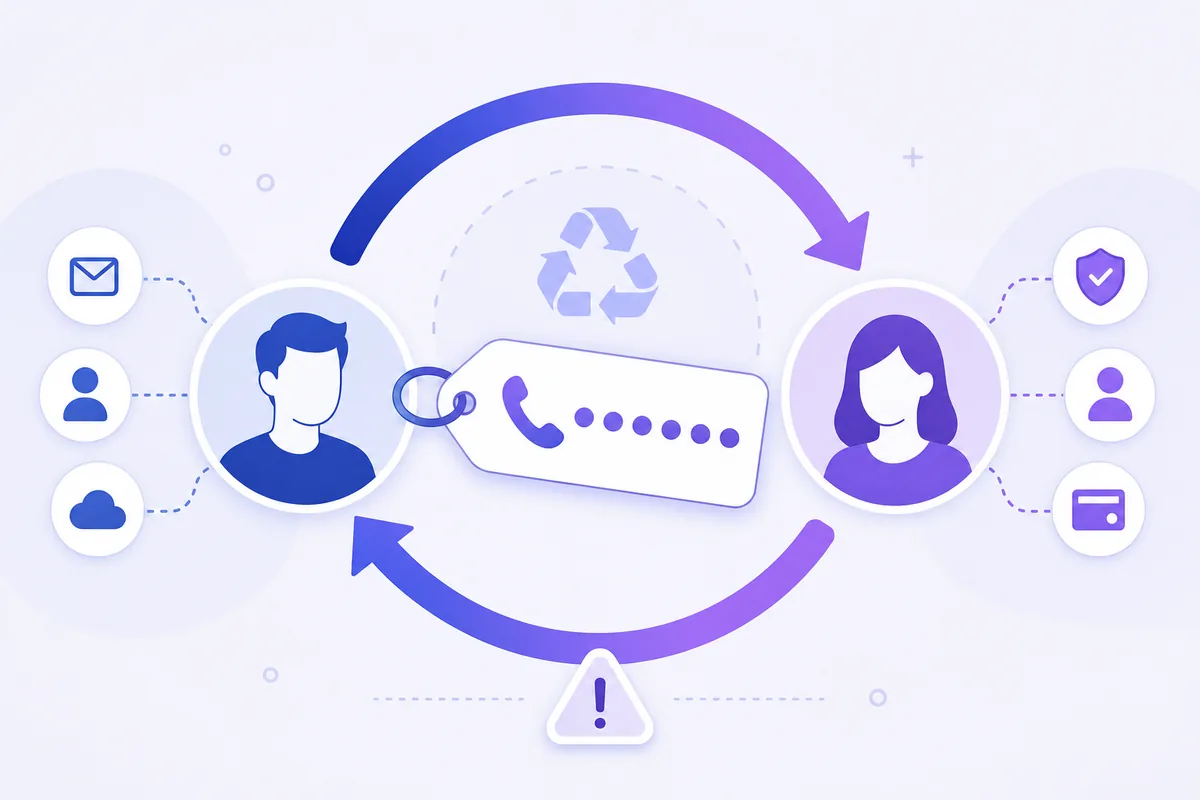
There’s a finite supply of phone numbers, so carriers don’t retire them — they recycle them. Give up a number, and after a dormancy period it goes to someone new. Usually harmless. But because so many accounts use a number for SMS verification and recovery, a recycled number can quietly hand account access to a stranger. Here’s the risk and how to avoid being on either side of it.
1. How number recycling works
When a number is disconnected, the carrier holds it for an “aging” period (often weeks to months), then returns it to the available pool and assigns it to a new customer. This keeps the limited numbering space usable — there simply aren’t enough numbers to permanently retire each one.
The mechanics are fine. The problem is everything that number was linked to while its old owner had it.
2. Why a recycled number is a security risk
Think about how many accounts are tied to your number: email recovery, banking alerts, social logins, two-factor codes. If the previous owner didn’t remove the number from those accounts before giving it up, the new owner can:
- Request a password reset that sends an SMS code to their (recycled) phone.
- Receive 2FA codes meant for the old owner’s accounts.
- Potentially take over accounts the number still unlocks.
| Party | Risk from recycling |
|---|---|
| Old owner | Their leftover-linked accounts become reachable by a stranger |
| New owner | May receive codes/resets for accounts that aren’t theirs |
| Service | Sends a valid code to the wrong human |
It’s not an attack so much as a dangerous accident — the number is doing exactly what it was told, for the wrong person.
3. How to protect yourself
Whether you’re leaving a number or taking on a new one:
- Before you drop a number, unlink it from every account — email, bank, social, 2FA — and switch those to another number or an authenticator app.
- On a new number, expect stray codes. If you receive resets or 2FA texts for accounts you don’t own, don’t use them — it means the number wasn’t cleaned up by its previous holder.
- For critical accounts, prefer a non-SMS second factor, so a future recycling of your number can’t unlock them.
The habit that matters most: treat “abandoning a number” like “changing your locks” — detach it from your digital life first.
4. What this means if you receive codes online
Recycling is a property of long-lived personal numbers that accumulate account links over time. A number you use briefly to receive a code online without a SIM isn’t your permanent identity anchor, so it doesn’t carry years of linked accounts the way a personal SIM does.
The broader lesson connects to number reputation: a number’s history follows it. That’s why, for accounts you intend to keep, it’s wise to anchor recovery to something more durable than a phone number that could one day belong to someone else.
FAQ
Q: Why did I get a verification code for an account that isn’t mine? You likely received a recycled number whose previous owner never unlinked it from their accounts. Don’t use the code; it’s not yours to act on.
Q: How long before a number is recycled? It varies by carrier and country, typically from a few weeks to several months of dormancy before reassignment.
Q: How do I stop my old number from exposing me? Before giving it up, remove it from every account and move 2FA to an app or a new number. Unlink first, disconnect second.
Takeaway
Phone numbers are recycled, not retired — so a number you abandon can later receive codes and resets for any account you left linked to it. Unlink a number from your accounts before letting it go, be wary of stray codes on a new number, and anchor your most important accounts to a factor more permanent than a phone number.