 SimSmsBox
 Quick answer: Credential stuffing is an attack where criminals take username-and-password pairs leaked from one breach and try them automatically across many other sites, betting that people reuse passwords. It’s cheap, automated, and works often because password reuse is rampant. The two things that stop it cold: unique passwords everywhere (so a leak can’t be reused) and 2FA (so a correct password still isn’t enough) — which is why a verification code matters even when your password is stolen.
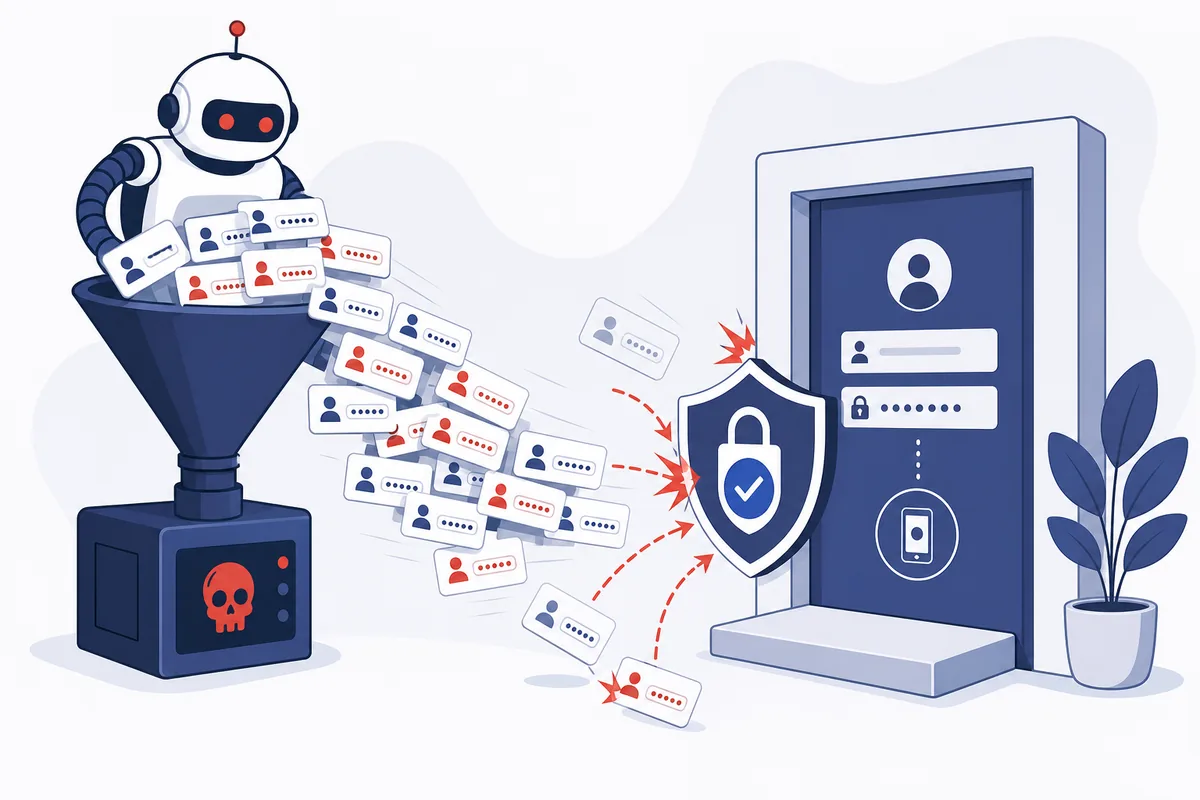
When a website gets breached, the stolen passwords don’t just harm that site. Attackers feed those millions of credentials into bots and try them everywhere else — your email, bank, shopping accounts. This is credential stuffing, one of the most common ways accounts get taken over, and understanding it shows exactly why 2FA is worth the small hassle.
1. How credential stuffing works
The attack is industrial in scale but simple in concept:
- A breach dumps millions of email/password pairs (often sold or leaked publicly).
- Attackers load them into automated tools that try each pair across hundreds of sites.
- Wherever someone reused that password, the login succeeds.
- The attacker takes over the account — or sells the working combination.
It costs almost nothing to try millions of logins, so even a low success rate is profitable. The entire attack rides on one human habit: password reuse.
2. Why it works so well
| Factor | Why it helps the attacker |
|---|---|
| Password reuse | One leak unlocks many sites |
| Automation | Millions of attempts, cheap |
| Huge breach databases | Endless credentials to try |
| No 2FA | A correct password = full access |
The uncomfortable truth is that credential stuffing succeeds not because of clever hacking, but because so many people use the same password in multiple places. It’s your reused password doing the attacker’s work.
3. The two defenses that actually stop it
- Unique passwords everywhere: if every site has its own password, a breach at one can’t be reused anywhere else. A password manager makes this practical.
- Turn on 2FA: even if an attacker has your correct password, they hit the second factor — an SMS code, authenticator app, or passkey — which they don’t have. The stuffed password alone gets them nowhere.
These two work together: unique passwords limit the blast radius of any breach, and 2FA neutralizes a stolen password even when reuse happens. This is the core reason services push 2FA so hard.
4. What this means if you receive codes online
Credential stuffing is exactly the scenario a verification code defends against. When a login also requires a code you receive online without a SIM, an attacker with your leaked password still can’t get in — the code never reaches them. Your second factor turns a “stolen password” into a non-event.
There’s a flip side worth noting: if you start receiving login codes you didn’t request, that’s a signal your password is already out there and being stuffed. Don’t enter the code — treat it as a prompt to change that password, the same caution behind OTP bot scams.
FAQ
Q: How is credential stuffing different from brute force? Brute force guesses passwords from scratch; credential stuffing reuses real passwords leaked from other breaches. Stuffing is far more effective because the passwords are genuine — just reused.
Q: Does 2FA really stop credential stuffing? Yes. Even with your correct password, the attacker is blocked by the second factor they don’t possess. 2FA is one of the most effective defenses against account takeover.
Q: I got a login code I didn’t request — what does it mean? Likely someone has your password and triggered a login. Don’t enter the code; change that password immediately, and make sure it’s unique.
Takeaway
Credential stuffing weaponizes leaked passwords by trying them everywhere, succeeding wherever you reused one. Unique passwords contain the damage and 2FA neutralizes a stolen password entirely — which is why a verification code protects you precisely when your password is already in an attacker’s hands.