 SimSmsBox
 Quick answer: Biometric 2FA uses something you are — a fingerprint or face scan — while SMS 2FA uses something sent to your phone as a code. Biometrics are fast, hard to phish, and never leave your device, but they’re usually a local unlock tied to one gadget rather than a code a server sends. SMS is universal and works anywhere, but it travels over the network. In practice they often work together: your face unlocks the phone that then receives or generates the code.
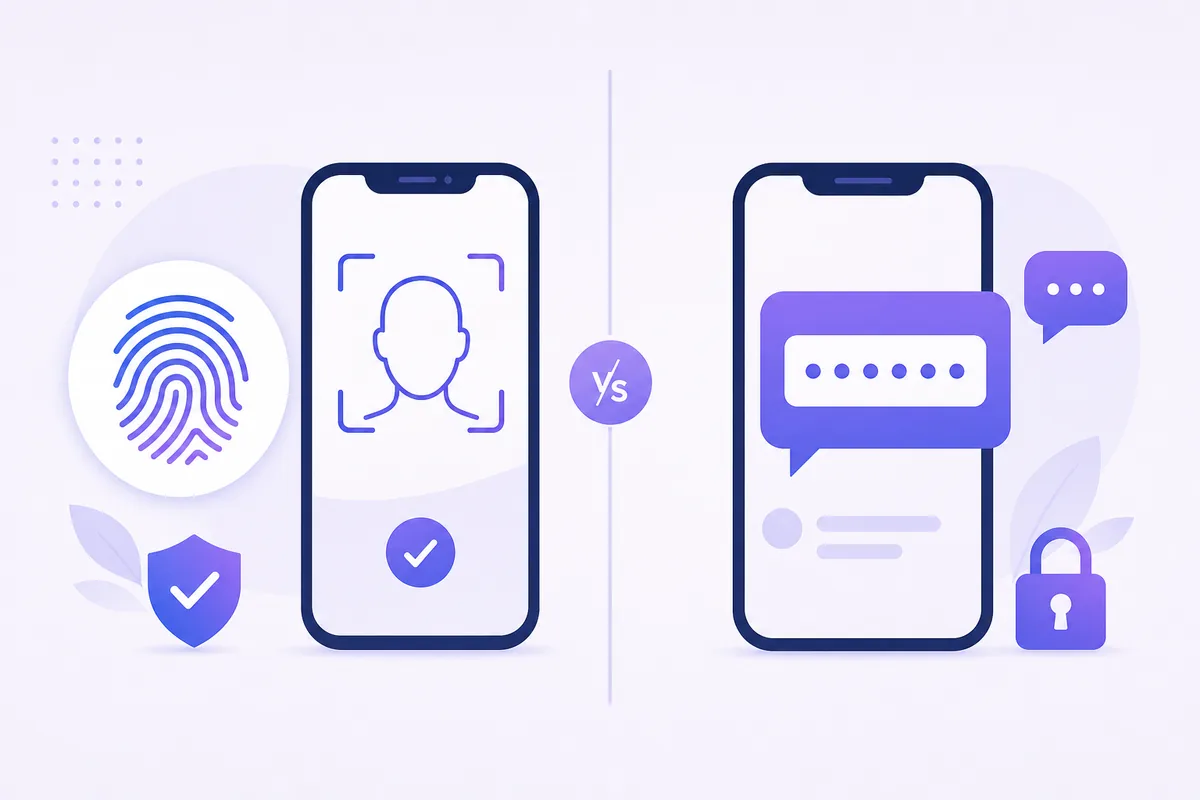
Unlocking a login with your face feels like the future; typing a texted code feels old-fashioned. But they’re not really competing for the same job. One proves you’re physically present at your device; the other confirms you control a phone number. Here’s how biometric and SMS verification actually differ and where each fits.
1. Something you are vs something sent to you
The two lean on different authentication factors:
- Biometric: a fingerprint, face, or iris scan. It’s an inherence factor — proof of who you physically are — and it’s typically checked locally on your device, with the biometric data never uploaded.
- SMS: a one-time code the service sends to your number. It’s a possession factor — proof you hold the phone — and it travels over the mobile network to reach you.
That “local vs sent” split explains most of the practical differences.
2. The trade-offs
| Factor | Biometric | SMS code |
|---|---|---|
| What it proves | You’re physically present | You control a number |
| Phishing resistance | Very high | Lower (codes can be phished) |
| Works across devices | No — tied to one device | Yes — any phone with a number |
| Needs a network | No (local check) | Yes |
| Main weakness | Device-bound; not remotely portable | Interception, SIM swap |
Biometrics shine at speed and phishing resistance on a device you hold; SMS shines at universality across any phone, anywhere.
3. Why they’re partners, not rivals
Here’s the subtlety: biometrics usually aren’t a standalone remote second factor. Your fingerprint doesn’t get sent to a website — instead it locally unlocks the phone or the authenticator app or passkey that actually authenticates. So biometric + SMS frequently stack: your face unlocks the device, and the device then receives the SMS code or approves the login.
In that sense, “biometric vs SMS” is less either/or than it looks. Biometrics protect the device; SMS confirms the number. Many secure setups use both.
4. What this means if you receive codes online
Biometrics are inherently device-bound — there’s nothing sent, so they can’t be received on a number at all. SMS is the opposite: a code goes to a number, which is precisely what lets you receive codes online without a SIM.
So if a login relies only on biometrics on a specific phone, an online number has no role. But most services still offer an SMS code path for portability and account recovery — and that texted code is the one an online number can complete, regardless of whether a fingerprint guards the device on the other end.
FAQ
Q: Is biometric 2FA more secure than SMS? For phishing resistance and local speed, yes. But biometrics are usually a device unlock, not a sent code — so they solve a different part of the problem than SMS.
Q: Can biometric verification be received on another device? No. Biometrics are checked locally on the device with the sensor; nothing is transmitted to receive elsewhere. Only sent factors like SMS work that way.
Q: Do biometrics replace SMS codes? Often they complement rather than replace: your fingerprint unlocks the phone or app that then handles the code or login approval.
Takeaway
Biometric 2FA proves you’re physically at your device; SMS proves you control a number — different jobs that often team up rather than compete. Because biometrics are device-bound and nothing is sent, they can’t be received on a number, while the SMS code remains the portable factor an online number can actually complete.